Pride flag coded in qb64 using the geometry of the flags coloured bars 💻 #pride #coding #programming #code #BASIC #64bit #geometry #qb64 #computing pic.twitter.com/mUxNdts363
— Mark Wall (he/him) ⛧⸸ⓥ🇮🇪🇪🇺 (@majwal7) December 17, 2022
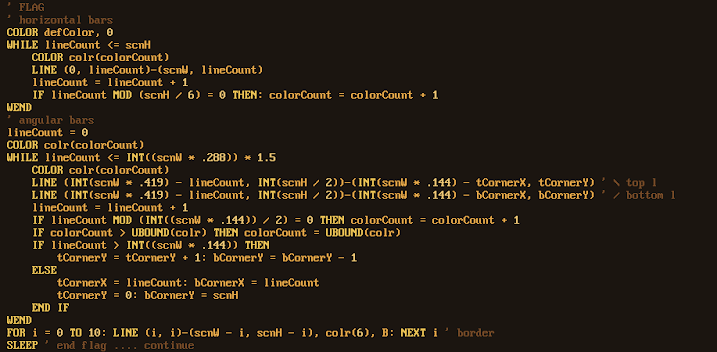
Pride flag coded in qb64 using the geometry of the flags coloured bars 💻 #pride #coding #programming #code #BASIC #64bit #geometry #qb64 #computing pic.twitter.com/mUxNdts363
— Mark Wall (he/him) ⛧⸸ⓥ🇮🇪🇪🇺 (@majwal7) December 17, 2022

When my absolutely 'stoned off my face at 4 a.m.' sativa-induced ramblings turn out to be absolutely 100% correct 👍@raymierussell - a far more precise offering to the geometry demon. Scalable pentagram vectors written in QB64 and compiled 64-bit #programming #pentagram #64bit pic.twitter.com/OFoJBe5UGJ
— Mark Wall (he/him) ⛧⸸ⓥ🇮🇪🇪🇺 (@majwal7) October 5, 2022

So the first DRAWn x, y co-ordinates are; -0.58r, r/0.555' ... The same method is then repeated a further four times to draw the line for each side of the pentagram.
When you want to summon a demon, but he demon is fussy about the precision of your pentagram! 😉 Drawing an inverted pentagram on a ZX Sprectrum as a scalable vector 'graphic' using the PLOT and DRAW commands. The idea is to denote the centre of the pentagram / circle as x, y co-ordinates (in pixels) represented with the variables x and y, and the radius (also in pixels) and represented with the variable r. Changing the x, y starting position and/or the radius (r) will redraw the pentagram according to the new values. To do this, each point on the pentagram, and hence each line can be represented as vectors.

The same method is then repeated for a further four times for each side / point of the pentagram.
 |
| Left: The starting point (bottom of pentagram) and fixe x, y co-ordinates for each subsequent line / point of the pentagram. Right: The same implemented in BASIC on the ZX Spectrum 128k (Fuse Emulator) |


A wave function in nested loops written in BASIC on a Sinclair ZX Spectrum 48k (Fuse Emulator) showing dissonant and resonant sine waves.


